Plan · asks firstPull 142 replays, 38 ticketsWalk the mobile checkoutRank hypothesesApprove
Research
Ask a question in a sentence. Get a cited brief back, or a moderated study on any topic.
 BETA
Join the waitlist +
BETA
Join the waitlist +
Fix what leaks. Ship what earns.AI finds, designs, tests and ships on one visual canvas your whole team works in.
Fix the problems that cost you revenue and build the new experiences that earn it, the way your best team would: evidence, hypothesis, test, proof. Run by AI, directed by you, on one canvas.
 Token Left: 500K
 Skills
 !−6.2% at addressPapproved
 Rpicked B
Test
 SmergedToken Left: 500K
Decision record #0412 is ready. Variant B won by 6.7 points.
SkillsReading your prompt and the goal behind itThe problem
AI made shipping fast. Knowing what to ship, and proving it paid off, is still slow.
Problems it solves
See it run
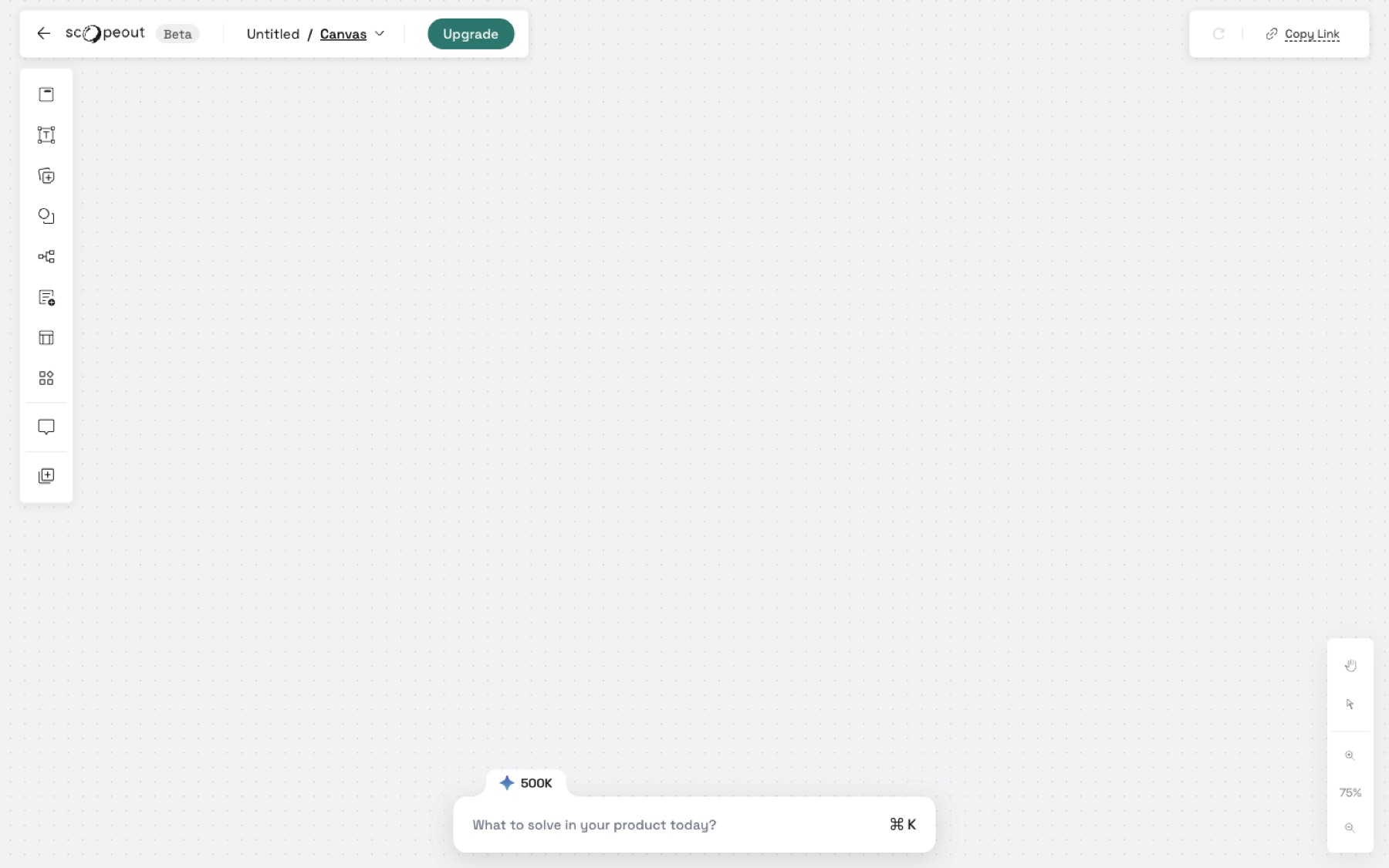
Scout walks your product, finds the leak, designs the fix in your system, builds it in your code and proves it worked. Your team approves every step.
The philosophy
Most AI tools take a prompt and give you output. Your best team takes a problem, or an idea for a new experience, and gives you proof: evidence, a hypothesis, a test, a result, written down. Scopeout is the second, run by the first.
The right method, five tools and six weeks. Nobody checked if it worked.
Prompt in, output out. No evidence, no test, no memory of what happened.
Your team’s method, run by AI: evidence, hypothesis, test, proof, record. Fix what leaks, ship what earns. You direct.
The same canvas, eight buckets
Each bucket is a real area of the canvas, not a separate tool. Open one to see it work.
Ask a question in a sentence. Get a cited brief back, or a moderated study on any topic.
Turn replays and tickets into experience maps and audits.
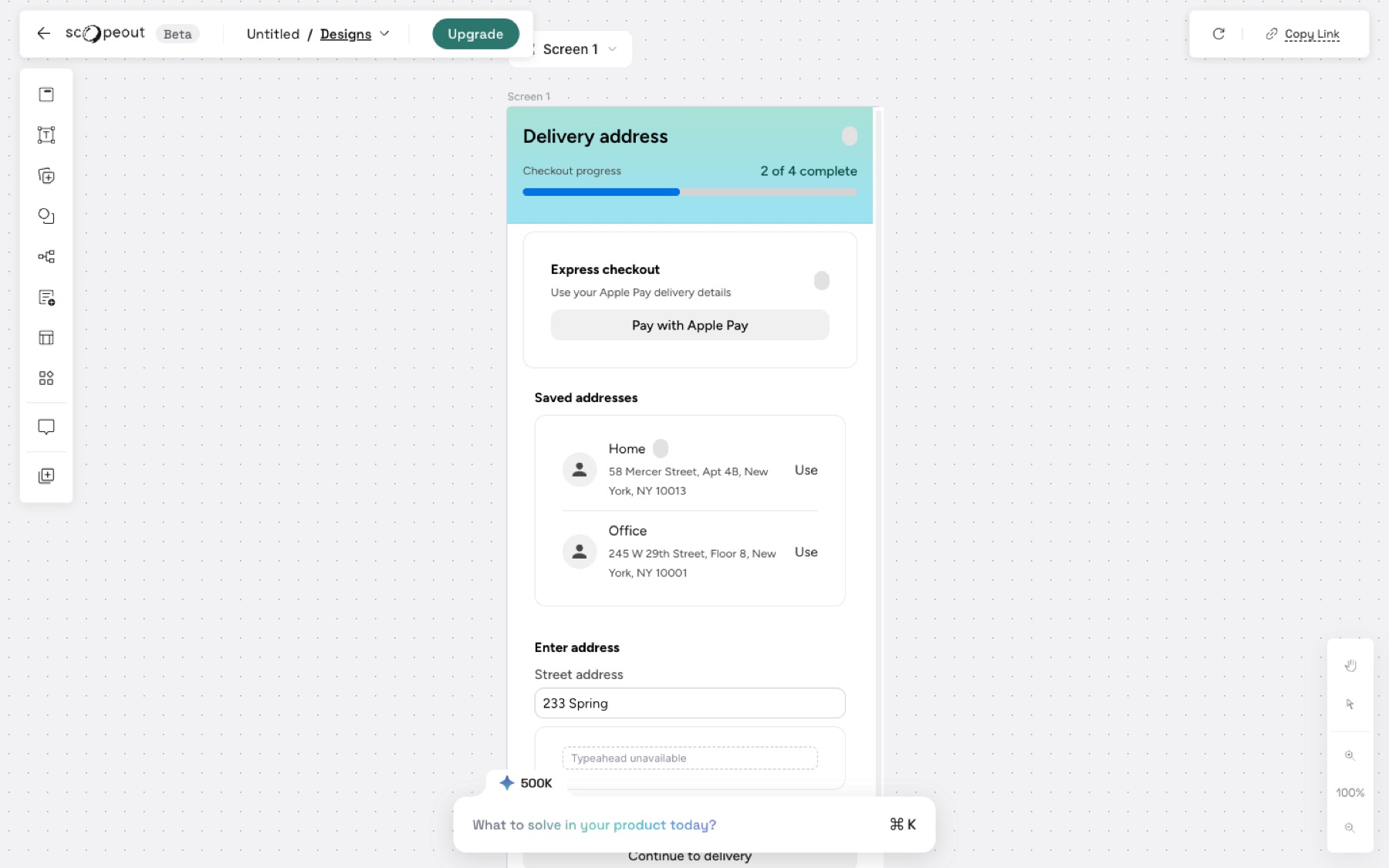
Generate screens on your design system. Edit them inline.
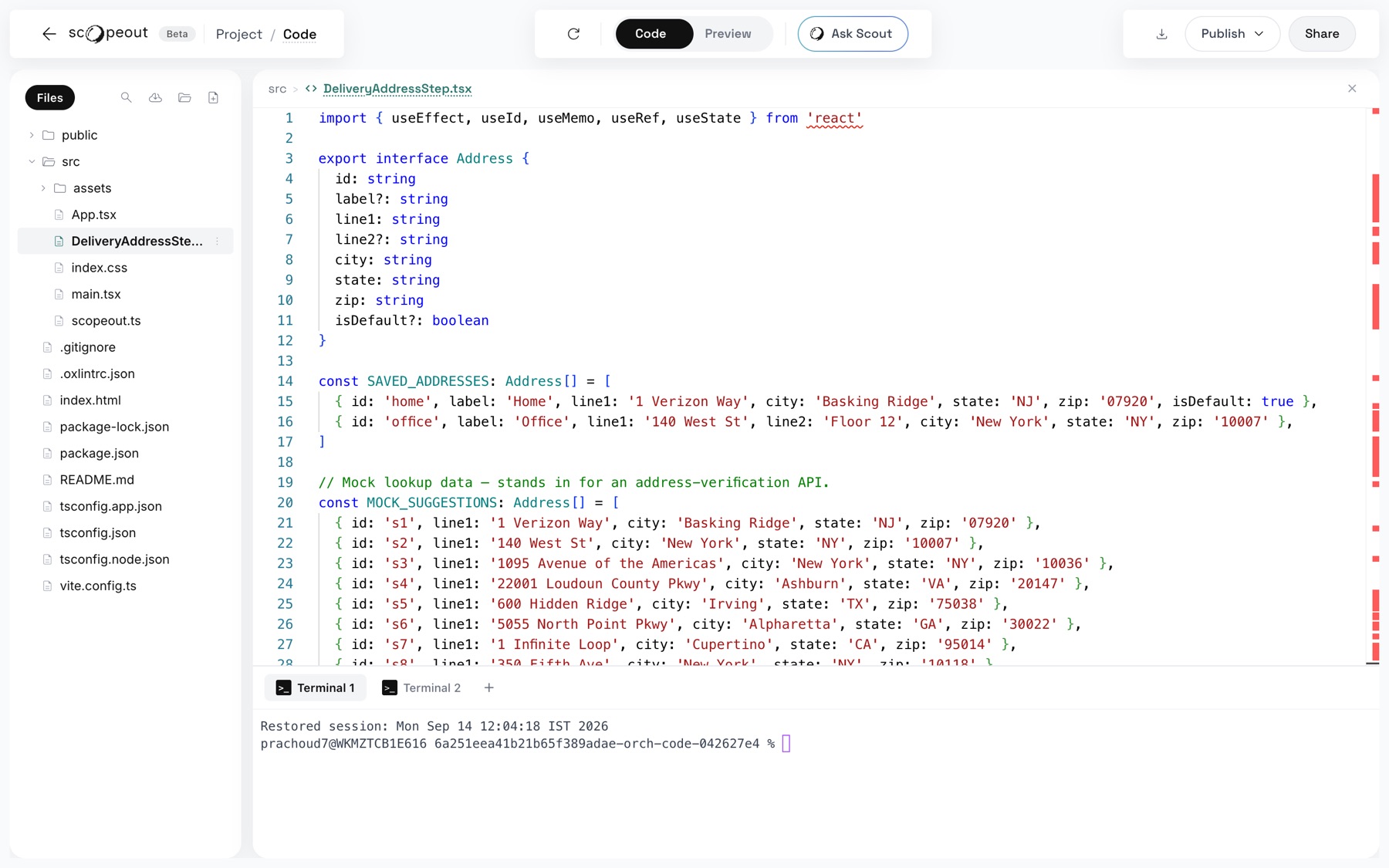
Take the chosen variant to a pull request, behind a flag.
A/B/n with guardrails, plus AI-moderated user interviews. Winners promote once they clear your bar.
Roll winners out in stages, with one-click rollback.
Watch every funnel step and release against its baseline.
Keep the record: problem, evidence, decision, outcome.
Start from a workflow
Every run starts with a sentence. Pick one and it opens on your canvas, already wired.
“A step in our funnel is losing people. Find out why and fix it.”
“New users stall before they get value. Find the blocker and test a fix.”
“Find the moment users are ready to pay and test the upgrade there.”
“Retention is slipping. Rank the reasons people leave and fix the top one.”
“Find what makes people come back, and give them more of it.”
“Find where customers are ready to buy more and test one offer.”
“Find the users who went quiet, why they left, and what brings them back.”
“Turn the most requested feature into a shipped, tested experience.”
What's next
One sentence sets the revenue goal and the guardrails. The canvas finds the leaks, writes the hypotheses, runs the tests, ships the winners, and learns your product as it goes. You approve the calls and watch the number move.
Watches every funnel around the clock and flags the leak before you ask.
Turns replays, tickets and data into one cause, with how sure it is.
Runs the fix against today, inside your guardrails, until it’s significant.
Ships the winner once you approve, and remembers what worked for next time.
FAQ
Those tools each cover one step. Scopeout runs the loop between them: it notices the drop, finds out why with cited evidence, draws the fix on your design system, ships it behind a flag, tests it, promotes the winner and writes down what happened. You direct; it runs; the record stays.
Anything. An idea in a sentence, a URL, a screenshot, a Figma file, a repo or a pile of tickets: start with whatever you have and Scout picks it up from there. Connect analytics, your repo, Figma and Slack when you want the full loop; each connector adds a step it can run.
A cited research brief in under an hour on day one. A first variant behind a flag in the first week, once the repo and design system are connected. The weekly digest starts the first Monday.
Every step has a dial. Out of the box: research and analysis run after you approve the plan; design proposes variants for you to pick; build opens pull requests your engineers review; test promotes only past the bar you set; publish waits for a named approver. Turn any of these up as trust grows.
No change reaches users without a flag, a guardrail and a person. Tests stop on a guardrail breach (refunds, errors, support volume), rollouts go out in stages, and any change rolls back in one click. Nothing merges on its own.
Into your repo, as a normal pull request with tests and a preview link, written in the stack and conventions the repo already uses. Your engineers review and merge it like any teammate's PR.
Connect Figma or Storybook and Design generates on your components and tokens, sized to real content, so what the team reviews is what ships. Edit inline or send it to Figma and back.
From the goal you give it and from your product model: what your users do by segment and what has worked for whom. It proposes loops ranked by expected lift with the evidence attached; you approve, reorder or drop them.
Every run writes problem, evidence, decision, approver and outcome as a block on the canvas, linked to the replays, tickets and PRs behind it. Anyone on the canvas can read it; roles decide who can approve. It exports to Notion, Confluence or PDF.
Your data is used only for your product and never to train models for other customers. It is encrypted at rest in Scopeout's cloud; enterprise plans add private deployment, SSO and a full audit trail.
Analytics (GA4, Mixpanel, Amplitude), support (Zendesk, Intercom), design (Figma, Storybook), code (GitHub, GitLab), docs and chat (Notion, Confluence, Slack), and a browser agent for anything with a URL.
That is where it does best. It learns your product from what already exists (code, docs, tickets, past experiments) so the first hypotheses come from your evidence, not a blank page.
Free to try, no credit card, cancel any time. Paid plans scale with the number of runs. Enterprise adds private deployment and SSO; contact us for that.
Private beta. We onboard teams in small batches. Or contact us.
We are onboarding teams in small batches. Tell us where to reach you and what you want to run first.
No spam. We email when your batch opens.
A question, a demo request, or a URL you want us to run through the canvas. We reply within a working day.
Prefer email? hello@scopeout.co
From hello@scopeout.co, to . If you included a URL, we will have run it before we write back.
 Scout
Scout